
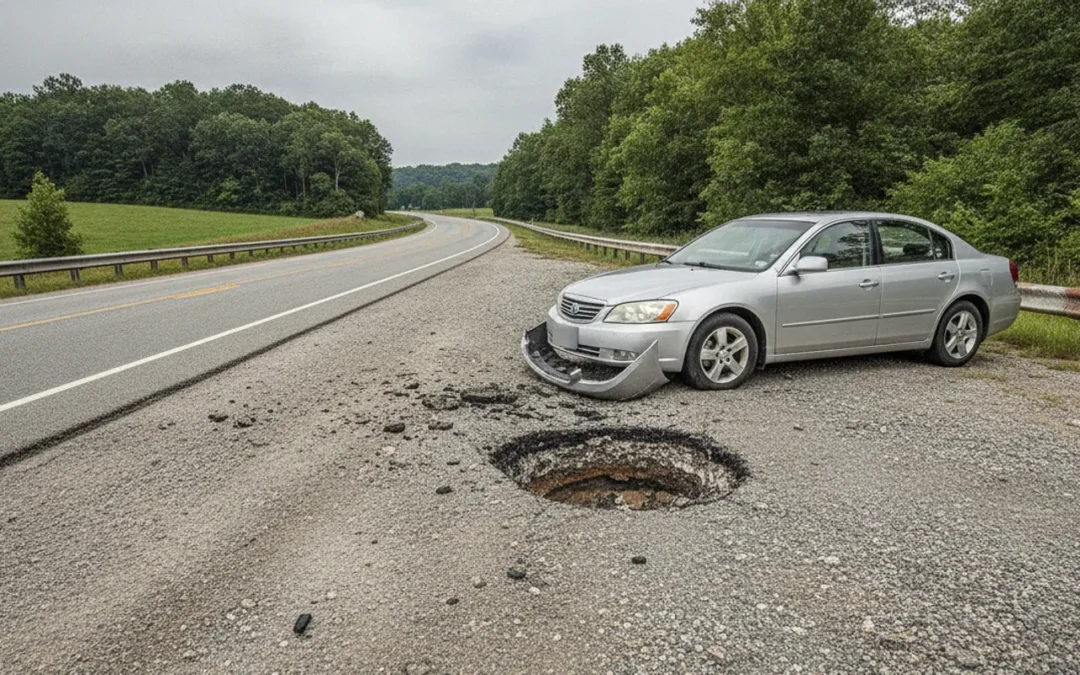
A road hazard car accident claim may involve more than the drivers who collided. A pothole, debris, a damaged roadway, or a work-zone condition may be relevant, but identifying a responsible party takes evidence and depends on the circumstances. If you were hurt in Louisville or elsewhere in Kentuckiana, learn what facts can shape a car accident case. You can also request a free, no-obligation case evaluation.
Request a free case evaluation
What counts as a road hazard in a crash?
A road hazard is a condition on or near a roadway that may affect a driver’s ability to see, steer, stop, or maintain control. Examples can include a deep pothole, loose material, fallen cargo, a missing or damaged sign, standing water, or an unsafe roadway edge. A hazard does not automatically establish that another person or organization is legally responsible. The evidence must connect the condition to the crash and show facts that may support responsibility.
Some crashes involve several contributing factors. A driver may have been moving too fast for conditions, another vehicle may have made a sudden maneuver, and an obstruction may have left little room to react. That is why a road hazard car accident claim should be considered alongside the full sequence of events, rather than assuming the visible hazard tells the whole story.
Who may be responsible for a road hazard?
Depending on where the hazard came from and who controlled the area, potential sources to investigate may include:
- A driver or vehicle owner: For example, evidence may show that unsecured cargo fell into the road or that a vehicle created an obstruction.
- A business or contractor: Work activity, materials, or equipment near a road may be relevant if they contributed to the dangerous condition.
- A public agency or other property controller: The roadway’s location, maintenance responsibilities, notice of a condition, and applicable legal rules may matter.
- More than one party: The conduct of multiple drivers or entities may need review when the facts suggest several contributing causes.
These are possibilities, not conclusions about any particular crash. Claims involving public roadways can have special procedures and legal issues. Do not assume that a photo of a pothole or debris alone proves who was responsible or that a claim can proceed against a particular entity.
What evidence helps explain how the hazard caused the crash?
Evidence is most useful when it documents the condition and connects it to the events before, during, and after the collision. If you can do so safely, note the exact location and direction of travel. Photographs or video may show the hazard, roadway layout, signs, lighting, weather, vehicle positions, and visible damage. Avoid entering traffic or putting yourself at risk to gather evidence.
Other useful records may include the crash report, witness names and contact information, vehicle damage photographs, towing or repair records, and medical records related to injuries. Keep original files when possible and record when and where each image was made. A short written timeline can help preserve details while they are fresh.
Information about who maintained or controlled the location may take more investigation. A lawyer may assess what records to seek and whether the roadway or work area had a responsible controller. Rick Hessig is both an attorney and a Licensed Professional Private Investigator; that background can inform investigation and case development, but it does not guarantee that evidence will establish liability.
What should you do after a crash involving a road hazard?
- Put immediate safety first. Move to a safe location if possible and contact emergency services when needed. Seek medical attention immediately for your injuries.
- Report the collision. Follow applicable reporting procedures and give accurate information. For more on this step, see how to report a car accident.
- Document what you can safely observe. Photograph the road condition and scene from a safe place. Note nearby signs, landmarks, road direction, and visible construction or maintenance activity.
- Identify witnesses. If someone saw the event, ask for their name and contact information. Do not pressure anyone to make a statement.
- Keep related records. Save report information, photos, medical paperwork, repair estimates, and messages from insurers or other parties.
- Be careful with assumptions. Do not guess about the cause or accept an explanation that you do not understand. Stick to what you observed.
For a broader sequence of practical steps, review this guide to what to do after a car wreck and the car accident checklist.
How can the investigation be organized?
A simple comparison can help you see which questions are open. It is not a legal determination, and the answer in any case depends on the facts.
| Evidence or issue | What it may help clarify | Practical next step |
|---|---|---|
| Photos or video of the road | Where the hazard was and how it appeared | Keep original files and note the location and time |
| Crash report and witness accounts | Vehicle movements, observations, and sequence | Save report details and witness contact information |
| Roadway control or work records | Who may have maintained or controlled the area | Record visible signs, project details, and location information |
| Medical and vehicle records | Injuries, treatment, and collision damage | Keep copies of records and repair documents |
| Insurance communications | What has been reported, requested, or offered | Keep written communications and ask questions before agreeing |
How do insurance and Kentucky rules fit in?
Insurance questions depend on the coverage involved, the parties, and the facts. A driver may need to notify an insurer, but a statement to an adjuster should be accurate and limited to what the person knows. Do not sign a release or accept a proposed resolution without understanding what it covers. This guide to handling an auto insurance claim after a Kentucky crash explains general considerations.
Responsibility may be disputed, and more than one person’s conduct can be examined. The crash report is useful information, but it is not necessarily the final answer to every legal question. A careful review may consider the road condition, driver actions, available records, and the rules that apply to the location and parties.
Because a roadway-related claim may involve a government entity or special notice requirements, do not rely on a general online article to calculate a filing deadline. Exact deadlines can depend on the claim and circumstances. Get legal guidance promptly if you are considering a claim.
Crash reports can also be useful as one piece of the record, but a report may not capture every detail about a road surface or obstruction. The International Road Assessment Programme’s Crash Data System overview describes how crash data systems collect and use police-reported crash information. That resource supports treating a report as a source of information, not as a complete substitute for other evidence about the scene.
What details should you write down while they are fresh?
A brief, factual note can help preserve details that may otherwise blur together. Record the date and approximate time, the road name or nearest intersection, your direction of travel, and the lane you occupied. Describe the hazard in ordinary terms: its approximate position, what you saw, and whether you noticed it before impact or only afterward. Separate what you personally observed from what someone else later told you.
Also note the sequence in short steps. For example: you approached a curve, noticed loose material, braked or steered, then felt an impact. Do not fill gaps by guessing about speed, distance, or the identity of a responsible party. If your memory changes or you learn a detail later, add the date of that note rather than silently rewriting the original account.
When preserving digital files, retain the originals and avoid editing them. If a phone automatically stores image details, keeping the original file may preserve useful context. Make a separate copy for sharing if needed. Do not post speculation or private medical information publicly; discuss records with an appropriate adviser instead.
How can you distinguish a hazard from the cause of a crash?
Seeing a hazard after a collision does not, by itself, show when it appeared, whether a driver could see it in time, or how it affected the vehicles. Consider a simple example: a driver swerves around an object and is struck by a vehicle in the next lane. The object may be relevant, but the investigation would also ask whether it was in the travel lane, how long it had been there if that can be established, what the drivers could see, and whether either driver had a safe way to respond.
In another situation, a pothole may damage a tire, after which the vehicle moves into another lane. Photographs of the pothole and damage may help, but the timing and condition of the tire, vehicle movement, road layout, and witness observations may also matter. These examples are not conclusions about fault. They show why a clear timeline and multiple kinds of evidence can be more informative than a single image.
For a related explanation of how facts are assessed, read how fault may be evaluated after a car accident and who may be liable after a Kentucky car crash.
What should you ask during a case evaluation?
A useful evaluation starts with clear questions and an accurate account. You may want to ask:
- What facts about the road condition and crash sequence still need to be established?
- Which people or organizations might have controlled or contributed to the hazard?
- What records or evidence should be preserved or requested?
- What insurance policies or parties may need to be considered?
- How are attorney fees handled, and what costs might remain my responsibility?
Rick Hessig Law represents people injured in car accidents in Louisville and Kentuckiana, including Southern Indiana. The firm offers free case evaluations and works on a “No Fee Unless You Win” basis for attorney fees, with no upfront attorney fee. In accordance with KBA regulations, we must inform you that case and court costs may be the responsibility of the client. A case evaluation does not promise representation or a particular outcome.
Start a free, no-obligation case evaluation
Frequently asked questions
Does a pothole automatically make a public agency responsible?
No. The roadway’s location, control, maintenance history, notice of the condition, and applicable legal rules may all matter. A pothole’s presence alone does not establish responsibility.
Can I make a claim if debris caused me to swerve?
Possibly, but the facts must be investigated. Relevant questions include where the debris came from, what each driver did, whether anyone witnessed the event, and what records exist. An evaluation can help identify issues to examine, but it cannot guarantee a claim or recovery.
What if I did not photograph the hazard?
Other evidence may still help, such as witness accounts, a crash report, vehicle damage, or records about the location. Write down what you remember and preserve related documents. Do not return to a dangerous roadway to take pictures.
Should I speak with an insurer before I know who caused the hazard?
Notify the appropriate insurer as required by your policy and provide accurate information. If you are unsure what a question or document means, consider getting advice before making a recorded statement or signing a release.
A careful next step
A road hazard car accident claim turns on more than the condition you noticed; the location, evidence, control of the area, and actions of everyone involved can all matter. Keep what you can safely preserve, get medical care for injuries, and seek a case evaluation if you want help understanding the questions in your situation.