
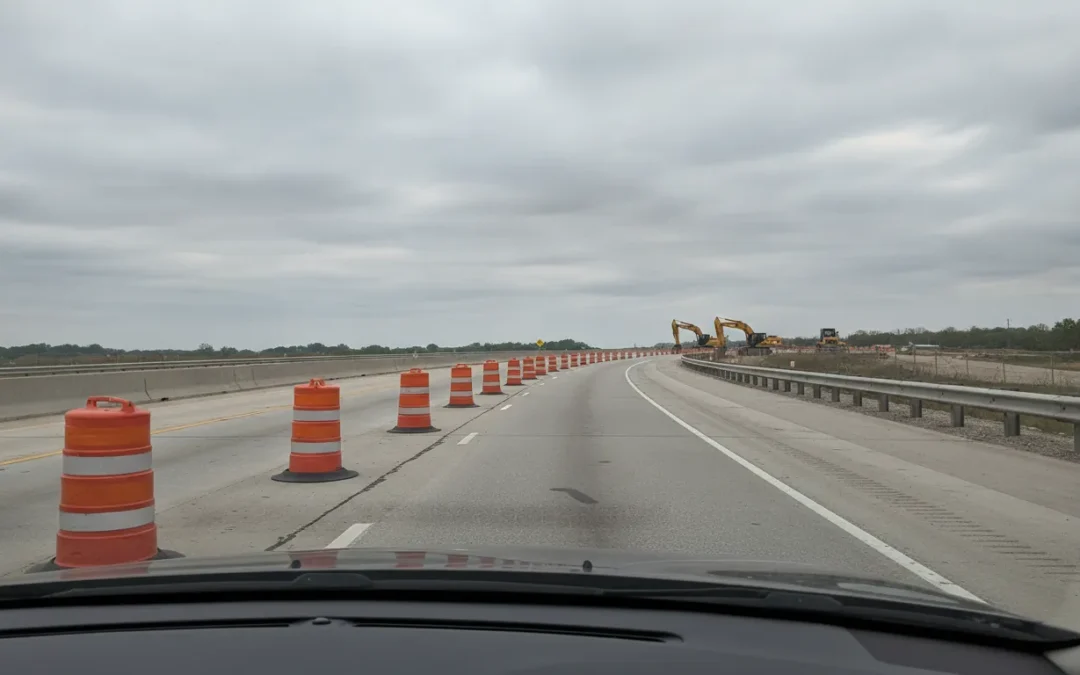
A car accident in construction zone traffic is not always a simple two-car crash. Lane shifts, stopped traffic, flaggers, and heavy equipment can change who may be responsible. In 2025, the Kentucky Transportation Cabinet reported 1,156 work zone crashes, 272 injuries, and 13 deaths. Every person who died was a driver or a passenger. Distracted driving was tied to 42 percent of those crashes.
Request a free case evaluation if you were hurt in a Kentucky work zone and want Rick Hessig to look at what happened.
This guide covers who may share responsibility after a Kentucky work-zone crash, which scene facts matter, and what to do in the first days. It does not promise a result. A work zone does not, by itself, decide fault.
Why a car accident in construction zone traffic is different
An ordinary crash often comes down to two drivers and a clear right of way. A work zone adds a temporary road. Barrels, cones, a narrowed lane, or a flagger may replace the markings you use every day.
The Kentucky Transportation Cabinet says driver behavior is still the leading cause of work-zone collisions. Speed was the second leading contributor in 2025. Impairment was a factor in 25 percent of the deaths. Those figures describe the statewide pattern. They do not decide any one crash.
Four facts often separate a work-zone crash from a normal one:
- The travel path may change from one day to the next.
- Traffic may stop suddenly behind a work crew or a slow truck.
- More than one company may have set up the zone.
- A public agency may own the road, while a contractor runs the work.
Kentucky also treats some work-zone violations differently. Under KRS 189.2327, certain traffic violations in a signed highway work zone carry a higher fine when at least one worker is present. A higher fine is not the same thing as civil fault. It is one more reason to slow down and follow the temporary signs.
If you want the broader picture of who can be responsible after any Kentucky crash, read who may be liable after a Kentucky car crash. The rest of this page stays on the work-zone setting.
Who may be responsible after a work-zone crash
Fault is a fact question. More than one person or company can share it. Kentucky’s shared-fault rules can reduce a recovery when an injured person also contributed. Those rules are explained in how shared fault affects a Kentucky car accident claim. This section only names the parties that come up in a work zone.
Another driver
The other driver is still the most common starting point. Speeding through a narrowed lane, following too closely, ignoring a flagger, or looking at a phone can all matter. A rear-end crash in a sudden queue is a frequent pattern, but the lead driver is not automatically free of fault.
A road contractor or subcontractor
The company doing the work usually sets the barrels, signs, and lane shifts under a traffic-control plan. A missing warning, a confusing shift, an unmarked drop-off, or equipment left in a travel lane can raise questions about that company. A subcontractor that cut the pavement or left a steel plate can be a separate question.
A public agency
The Kentucky Transportation Cabinet, a city, or a county may own or maintain the road. A claim involving a public agency can follow different rules than a claim against a driver or a private contractor. This page does not set out notice deadlines. If a government vehicle or a public road may be involved, get that question reviewed early.
A worker, flagger, or work vehicle
A flagger directing traffic, a dump truck entering a lane, or a worker’s vehicle stopped in the travel path can be part of the story. The employer of that person may also be relevant. Do not assume a worker is at fault because the crash happened near the crew, and do not assume the worker is blameless.
| Possible party | What to look for | Why it can matter |
|---|---|---|
| Another driver. | Speed, following distance, phone use, or an ignored flagger. | Driver conduct is the leading work-zone crash factor in Kentucky. |
| Contractor. | Missing signs, a confusing lane shift, or equipment in a lane. | The contractor often controls the temporary setup. |
| Subcontractor or utility. | Open cuts, steel plates, or a separate lane closure. | More than one company may have worked the same stretch. |
| Public road agency. | Who owns the road, and who accepted the work. | Claims against a public body can follow different rules. |
| Work vehicle or flagger. | A truck entering the lane, or a direction you could not follow. | The employer, not only the person on site, may be involved. |
A police citation, if one is issued, is evidence. It is not the last word on civil responsibility. Insurers often form their own view, and that view can change as photos, statements, and the crash report come in.
What to notice before you leave the zone
Safety comes first. If you can do so without further risk, move out of the travel lane. KRS 189.580 requires a driver in an injury crash to stop and render reasonable assistance.
On an interstate or parkway, a crash with no death, known injury, or hazardous material should be moved off the roadway. Do that only when it can be done safely.
Seek medical attention immediately for your injuries. Adrenaline can hide a neck, back, or head injury until later. Getting checked also creates a record of what you felt that day.
Work zones change fast. Crews may pick up barrels the same afternoon. If you are able, note or photograph:
- The nearest mile marker, exit, or cross street.
- Barrels, cones, arrow boards, and any lane shift.
- Whether a flagger or a worker was present.
- Skid marks, debris, and where each vehicle stopped.
- Equipment or a drop-off near the travel lane.
- The names of other drivers and any witness who stopped.
Do not walk into live traffic to get a better photo. A phone picture from a safe shoulder is enough to start. If a truck or a work vehicle was involved, the markings on the door can help identify the company later. For crashes that involve a commercial truck, see what evidence matters in a Kentucky truck crash.
You do not have to give a recorded statement at the scene. Share your name, registration, and insurance as the law requires. Leave the longer account for a calmer moment.
How a crash report and photos fit together
Kentucky law requires notice to law enforcement after some highway crashes. That includes a death, a known or visible injury, or damage that leaves a vehicle unable to be driven.
KRS 189.635 puts the Kentucky State Police in charge of the statewide crash-reporting system. An officer who investigates files a written report with that officer’s agency.
If an officer responded and said they would complete the report, you do not also file a civilian collision report. The Kentucky State Police explain that on their civilian collision reports page. Ask how to request a copy, and keep the report number if you are given one.
Read the report when you get it. Check the location, the diagram, and any statement attributed to you. A mistake in a name, a direction of travel, or a lane description is easier to flag early than months later.
Photos fill gaps the report may miss. A diagram might say “construction” without showing whether the warning signs faced your direction. Your pictures can show the barrel line, the merge, and how close the work was to the lane. Keep the original files. Do not crop them in a way that drops the date.
For a wider look at proof, not just work-zone proof, see how to prove fault in a car accident. The work-zone pieces to add are the temporary signs, the traffic-control setup, and who was working that day.
What can shape a work-zone claim
No article can tell you what a claim is worth. Value depends on the facts, the injuries, the insurance, and how fault is shared. These are the points that tend to matter in this setting.
- How the zone was set up. Advance warning, a clear path, and a flagger who could be seen all matter. A setup that matched the plan is a different story from one that did not.
- What each driver did. Speed, a phone, a sudden merge, or a stop with no warning can all be part of the proof. So can a careful driver who had no time to react.
- Your injuries and treatment. Gaps in care, or a delay before you were checked, often become part of the insurer’s questions. The medical facts themselves are covered in what to do next after car accident injuries in Kentucky.
- Which insurance applies. A private driver’s policy, a contractor’s policy, and a commercial policy are not the same. Kentucky is not a pure no-fault state for every loss. Read whether Kentucky is a no-fault state before you assume a claim stays inside your own policy.
- The car itself. Where the vehicle goes, and whether it is repaired before anyone inspects it, can affect later proof. See what to do with your car after an accident.
The broader list of facts that shape any Kentucky car case is in what facts shape a car accident case. Use that page for the general framework. Use this one for the work-zone facts those pages do not cover.
Practical next steps in the first days
The general post-wreck checklist lives in what to do after a car wreck. The steps below are the ones that are easy to miss when the crash happened between barrels.
- Get medical care, even if you plan to “wait and see.” Tell the clinician the crash was in a work zone and describe the impact.
- Write down the location while it is fresh: highway, direction, mile marker, and which lanes were closed.
- Save photos of the setup, the vehicles, and your visible injuries. Back them up.
- Request the crash report and read it for errors in the diagram or your statement.
- Identify the contractor if a sign, vest, or truck door showed a company name. Write it down exactly.
- Notify your insurer as your policy requires, but do not guess about fault or your injuries.
- Keep repair and medical papers in one folder, including any out-of-pocket costs.
- Avoid posting about the crash. A casual line about “being fine” can be taken out of context later.
If distraction may have played a part, the evidence steps in what to do after a distracted driving accident can help you preserve phone and witness details. Do not accuse someone of phone use unless you saw it or the report says it.
Talk with Rick about your work-zone crash before you sign a release or agree that the crash was only your fault.
How Rick Hessig Law can help
Rick Hessig Law is a Louisville firm focused on people hurt in car wrecks in Kentucky and Southern Indiana. Rick is a Kentucky lawyer and a licensed investigator. He looks at the crash himself instead of handing you to a call center.
A work-zone case can need more than a police report. Photos of a lane shift, the name on a contractor truck, and a clear account of the warning signs can change how an insurer sees the crash. There is no fee unless you win, and no upfront attorney fee. In accordance with Kentucky Bar regulations, case and court costs may be the client’s responsibility.
A free case evaluation is a conversation about what happened. It is not a promise that the firm will take the case, and it is not a prediction of what an insurer will pay. If a public agency or an out-of-state contractor may be involved, say so at the start so the right questions get asked.
You can call the KY Injury Hotline at 502-777-1111. Car wreck? Call Rick.
Frequently asked questions
Who is usually responsible for a car accident in a construction zone?
Often it is the driver whose speed, following distance, or distraction caused the impact. A contractor, a subcontractor, a flagger’s employer, or a public road agency can also share responsibility when the setup or a work vehicle played a part. The zone itself does not assign fault.
Does a higher work-zone fine mean the other driver is at fault?
No. Kentucky can impose a higher fine for certain violations in a signed highway work zone when a worker is present. A citation is evidence. Civil fault still depends on what each person did and how the zone was set up.
What should I photograph after a work-zone crash?
From a safe place, photograph the barrels or cones, any lane shift, warning signs, vehicle positions, and nearby equipment. Note the highway, direction, and nearest mile marker. Crews may remove the setup the same day, so early photos are hard to replace.
Do I file my own report if an officer came to the scene?
If the officer said they would complete the report, you do not also file a civilian collision report. Ask how to get a copy, then read the location, diagram, and any statement attributed to you.
Can I still bring a claim if I may share some fault?
Possibly. Kentucky shared-fault rules can reduce a recovery when you also contributed. They do not automatically end every claim. How that applies depends on the facts, which a short article cannot decide for you.
A careful next step
A car accident in a construction zone leaves a short window to record a setup that may be gone tomorrow. Get medical care, save the scene, and read the crash report before you accept someone else’s version of fault.
This information is for general informational purposes only and is not legal advice. Reading this article does not create an attorney-client relationship with Rick Hessig Injury Law. To see if we may be able to help, please request a free case evaluation.